Namecheap Private Email SMTP Settings
Namecheap's own hosted mailbox service for domains, sold as Starter, Pro and Ultimate.
Search for your email provider
Outgoing mail (SMTP)
SMTP server
mail.privateemail.com
Port. STARTTLS
587
Port. SSL/TLS
465
Security
SSL/TLS on 465 (recommended) or STARTTLS on 587.
Incoming mail (IMAP)
IMAP server
mail.privateemail.com
Port. SSL/TLS
993
Port. STARTTLS
143
Incoming mail (POP3)
POP3 server
mail.privateemail.com
Port. SSL/TLS
995
Port. STARTTLS
110
Sending limits & login
Daily send limit
Per-plan hourly and daily send limits apply.
Authentication
Sign in with your full email address and mailbox password.
App password
No separate app password is required. Use the mailbox password set in the Private Email dashboard.
All Namecheap Private Email protocols share the single host mail.privateemail.com.
Sending cold email? EmailChaser manages inboxes, warmup and deliverability for you.
Try EmailChaser freeFind the SMTP, IMAP and POP3 server settings for any email provider. Free, with no signup, every field copies with one click.
Namecheap Private Email SMTP, IMAP and POP3 settings
Private Email is Namecheap's mailbox product, bought alongside a domain and billed in the Namecheap account panel. New subscriptions bought from 2 June 2026 run on Namecheap's own platform infrastructure, and existing subscriptions are being moved across in stages during August 2026; the hostname mail.privateemail.com stays the same either way. Sending limits are counted per domain rather than per mailbox, which catches out people running several addresses.
For incoming mail, use the IMAP server mail.privateemail.com on port 993, or POP3 at mail.privateemail.com on port 995. Pick the exact values from the tool above and copy them straight into your mail client.
Checked against Namecheap Private Email's own documentation: namecheap.com. Ports and limits change, so check there too if something will not connect.
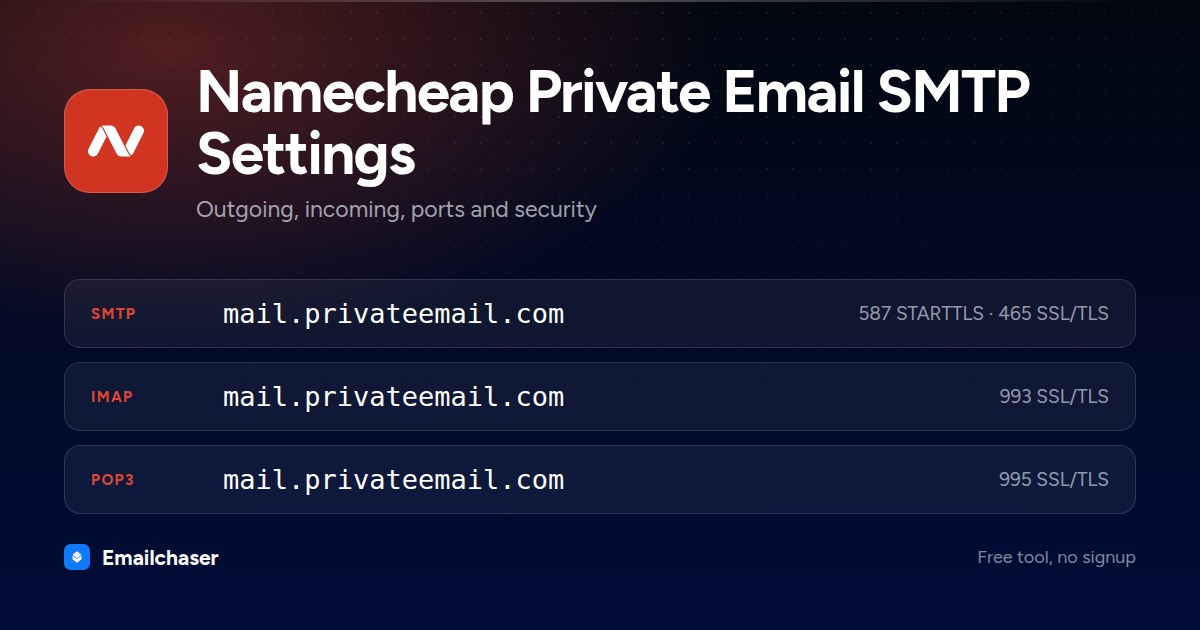
Namecheap Private Email settings at a glance
One card with every server and port on it. Right click to save it, or share the page and this is the preview people see.
What to enter as your Namecheap Private Email username and password
Wrong credentials, not a wrong port, are the usual reason a Namecheap Private Email connection fails. These are the exact values to type.
Your full Private Email address, for example you@yourdomain.com
Your mailbox password, or an application-specific password if two-factor authentication is switched on
Get your application-specific passwordHow to set up Namecheap Private Email in a mail client
The exact path through Namecheap Private Email's own settings, in order.
- 1
Create the mailbox in your Namecheap account
Sign in to Namecheap, open the Private Email subscription, add the mailbox address and set its password.
- 2
Point the domain's mail records at Private Email
In the Namecheap dashboard click Manage next to the domain, open the Advanced DNS tab, scroll to Mail Settings and choose Private Email, then Save changes. Allow up to 30 minutes.
- 3
Enter the incoming server
mail.privateemail.com on port 993 with SSL for IMAP, port 143 with STARTTLS as the alternative, or port 995 with SSL for POP3.
- 4
Enter the outgoing server
mail.privateemail.com on port 465 with SSL or port 587 with STARTTLS. Switch outgoing server authentication on and switch Secure Password Authentication (SPA) off.
- 5
If two-factor is on, create an application password
In webmail at https://privateemail.com go to Settings, Security, Application Passwords, pick your client from the drop-down, name the password and click Add new password. The password is shown once, so copy it straight away.
What Namecheap Private Email looks like filled in
Every mail client asks for the same handful of fields. Here they are with Namecheap Private Email's values already in place.
Account settings: Namecheap Private Email
Server
mail.privateemail.comPort
465Encryption
SSL/TLSAuthentication
RequiredUsername
Your full Private Email address, for example you@yourdomain.comPassword
Your mailbox password, or an application-specific password if two-factor authentication is switched onServer
mail.privateemail.comPort
993Encryption
SSL/TLSAn illustration of the fields, not a screenshot of any one app. Field names differ slightly between Outlook, Apple Mail and Thunderbird; the values do not.
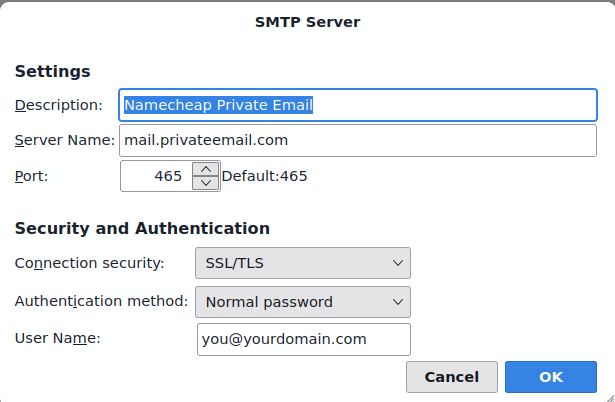
Namecheap Private Email SMTP settings in Thunderbird
The outgoing server dialog with Namecheap Private Email's details entered. Outlook and Apple Mail ask for the same four things under slightly different names.
Which port should you use for Namecheap Private Email?
SSL/TLS on 465 (recommended) or STARTTLS on 587.
STARTTLS
Starts as a plain connection, then upgrades to an encrypted one. The modern standard for sending.
SSL/TLS
Encrypted from the first byte. Widely supported and a good choice when 587 is blocked.
Plain SMTP
Meant for server-to-server relay. Home networks and cloud hosts block it, so do not use it to send from a client.
Why your Namecheap Private Email connection is failing
The failures people actually hit with Namecheap Private Email, and what fixes each one.
Namecheap's 2FA covers the web interface only. Create an application-specific password at Settings, Security, Application Passwords in privateemail.com webmail and put that in the client.
Namecheap states that only encrypted connections are supported by its mail servers. Use 993, 995 or 465 with SSL, or 143 or 587 with STARTTLS.
Untick Outlook's 'Secure Password Authentication (SPA)' box. Namecheap's setup documentation requires SPA off while outgoing server authentication is on.
The hourly ceiling is per domain, not per mailbox: 500 an hour on Starter, 1,000 on Pro, 1,500 on Ultimate, plus a 2 GB per hour outgoing traffic quota shared by the domain.
Namecheap's limits page lists .ru, .xn--p1ai, .by, .xn--90ais and .su as unavailable on every Private Email plan, and .tk, .ml, .ga, .cf, .gq and .za.com as unavailable on trial plans. Check the extension before buying.
Namecheap Private Email sending limits
Everything is metered per domain rather than per mailbox, and a separate 2 GB per hour outgoing traffic quota can throttle sending before the message count is reached. MIME encoding inflates an attachment by roughly 40%, so a 35 MB file already fills the 50 MB message ceiling.
Per hour
500 emails per hour per domain on Starter, 1,000 on Pro, 1,500 on Ultimate; 500 on the legacy Private, Business and Business Office plans; 50 on trial plans
Recipients per message
50 across To, Cc and Bcc
Max attachment
50 MB maximum outgoing message; 25 MB for a single file uploaded in webmail
Compare all 51 providers' sending limits in one table with a source link and a confidence rating for each.
Namecheap Private Email quirks by mail client
Outlook
Namecheap's Outlook instructions say explicitly to untick Secure Password Authentication and tick outgoing server authentication.
other
Exchange ActiveSync is not carried over to the new Private Email platform, so phones set up that way need rebuilding as IMAP. On the old platform ActiveSync showed only 90 days and about 1,800 messages of history.
Sending cold email through Namecheap Private Email
Per-plan hourly and daily send limits apply. Sign in with your full email address and mailbox password.
Those caps make single-mailbox sending fine for personal mail but a poor fit for cold outreach at volume. Emailchaser spreads sending across warmed inboxes and manages deliverability, so you can scale without burning Namecheap Private Email accounts.
A new Namecheap Private Email mailbox also starts with no sending history, and hitting the cap above on its first day is what gets it filtered. Warm the mailbox up first so its daily volume climbs gradually toward that limit rather than starting at it. Emailchaser includes that ramp on every plan.
Other business email and web hosting
Setting up more than one mailbox? These sit in the same category as Namecheap Private Email.


Common questions about Namecheap Private Email SMTP settings
What are Namecheap Private Email's SMTP settings?
Namecheap Private Email's outgoing (SMTP) server is mail.privateemail.com. Use port 587 (STARTTLS) or 465 (SSL/TLS). SSL/TLS on 465 (recommended) or STARTTLS on 587. Sign in with your full email address and password (or app password).
What is Namecheap Private Email's IMAP or POP3 server?
Namecheap Private Email's incoming IMAP server is mail.privateemail.com on port 993 (SSL/TLS). If you prefer POP3, use mail.privateemail.com on port 995.
Which port should I use for Namecheap Private Email?
Use port 587 with STARTTLS wherever it's offered, it's the modern standard for authenticated sending. Port 465 with SSL/TLS is a solid alternative. Avoid port 25, which most networks block for client sending. Namecheap Private Email's recommended value is above.
Why won't my Namecheap Private Email SMTP connection work?
Check authentication first: Sign in with your full email address and mailbox password. No separate app password is required. Use the mailbox password set in the Private Email dashboard. Then confirm the host, port and security method match exactly, a 587/SSL or 465/STARTTLS mismatch will fail to connect.
Can I send bulk or cold email through Namecheap Private Email?
Not at scale. Per-plan hourly and daily send limits apply. Providers throttle bursts to fight spam, so pushing cold email through one mailbox hits limits and wrecks deliverability. High-volume outreach belongs on dedicated infrastructure that spreads sending across warmed inboxes, which is what Emailchaser does.
Do my settings change now that Private Email runs on Namecheap's own platform?
No. Namecheap says the DNS records stay as they are, and your IMAP, POP3 and SMTP settings keep working without reconfiguration. What changes is the webmail interface and the feature list: Docs, Sheets and Presentations, OX Drive, ActiveSync, Unified Mail and public calendars are not on the new platform.
Why did my mail stop sending after only a few hundred messages?
The hourly ceiling is shared across every mailbox on the domain, so a newsletter from one address can lock out the rest. There is also a 2 GB per hour outgoing traffic quota, so a handful of large attachments can trip the limit long before the message count does.
Can I use a mail client if I have two-factor authentication turned on?
Yes, but not with your normal password. Go to Settings, Security, Application Passwords in webmail and generate a password for the specific client, then use that in place of your mailbox password. The same mechanism covers OX Drive, CalDAV and CardDAV connections.
Ready to 10x your pipeline?
Send your first cold email campaign today.
Start my free trial