Microsoft 365 SMTP Settings

Microsoft 365 work mailboxes on Exchange Online, sending through smtp.office365.com
Search for your email provider
Outgoing mail (SMTP)
SMTP server
smtp.office365.com
Port. STARTTLS
587
Security
STARTTLS on 587. Port 465 (SSL/TLS) is not supported for Microsoft 365 SMTP AUTH.
Incoming mail (IMAP)
IMAP server
outlook.office365.com
Port. SSL/TLS
993
Incoming mail (POP3)
POP3 server
outlook.office365.com
Port. SSL/TLS
995
Sending limits & login
Daily send limit
Up to 10,000 recipients per day and 30 messages per minute per mailbox.
Authentication
SMTP AUTH must be enabled on the mailbox by a Microsoft 365 admin: it is off by default on many tenants. Microsoft has disabled Basic Authentication for IMAP and POP on Exchange Online, so those protocols now require OAuth/modern auth on most tenants and an app password often will not connect.
App password
Use an app password if security defaults or MFA are enforced and SMTP AUTH still allows Basic Auth; otherwise the client must sign in with modern auth (OAuth).
For business Microsoft 365 / Exchange Online mailboxes on a custom domain. GoDaddy, and many resellers, sit on these same servers.
Sending cold email? EmailChaser manages inboxes, warmup and deliverability for you.
Try EmailChaser freeFind the SMTP, IMAP and POP3 server settings for any email provider. Free, with no signup, every field copies with one click.
Microsoft 365 SMTP, IMAP and POP3 settings
Office 365, sold today as Microsoft 365, is the paid business mail service behind smtp.office365.com. Authenticated SMTP is switched off for every organization created after January 2020, so an admin has to tick Authenticated SMTP on the individual mailbox before an app or printer can send anything. Exchange Online also requires TLS 1.2 or later, and a device that defaults to port 465 will not connect.
For incoming mail, use the IMAP server outlook.office365.com on port 993, or POP3 at outlook.office365.com on port 995. Pick the exact values from the tool above and copy them straight into your mail client.
Checked against Microsoft 365's own documentation: learn.microsoft.com. Ports and limits change, so check there too if something will not connect.
Microsoft 365 settings at a glance
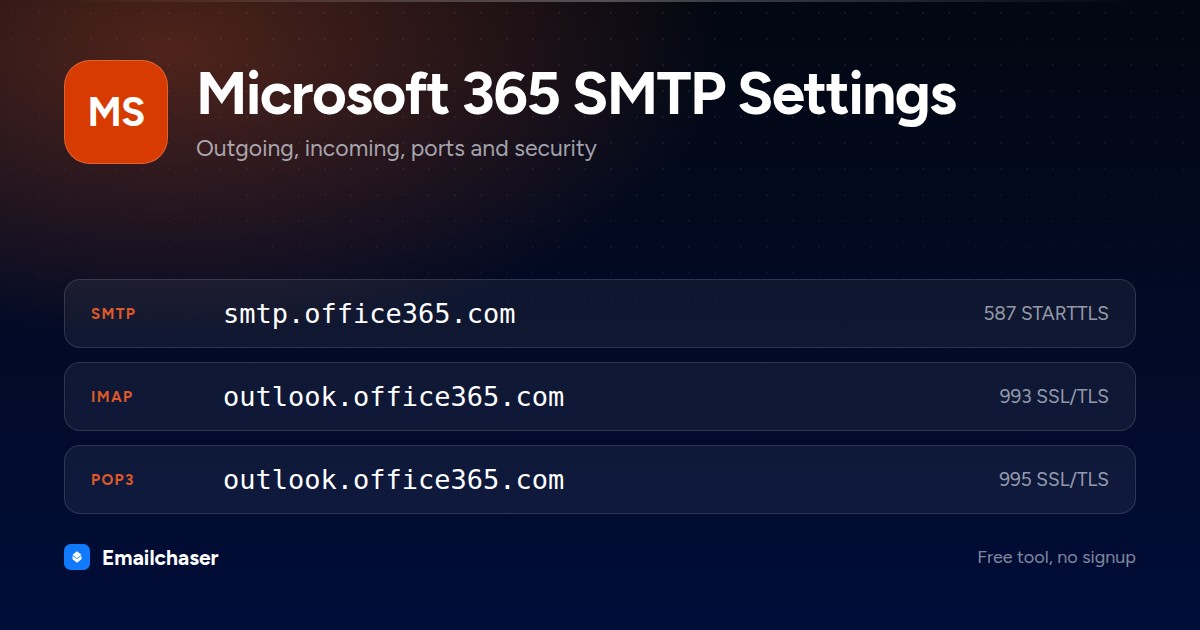
One card with every server and port on it. Right click to save it, or share the page and this is the preview people see.
What to enter as your Microsoft 365 username and password
Wrong credentials, not a wrong port, are the usual reason a Microsoft 365 connection fails. These are the exact values to type.
The licensed mailbox address, which also has to be the From address unless you grant Send As
That mailbox's own sign-in password, or an OAuth token where the app supports modern authentication
How to set up Microsoft 365 in a mail client
The exact path through Microsoft 365's own settings, in order.
- 1
Pick a licensed mailbox for the app to sign in as
Client SMTP submission needs a real licensed Microsoft 365 mailbox, and the address it sends From has to be that same mailbox.
- 2
Turn on Authenticated SMTP for that mailbox
In the Microsoft 365 admin center at https://admin.microsoft.com go to Users, Active users, select the user, Mail, Manage email apps, tick Authenticated SMTP and save.
- 3
Check the organization-wide switch as well
In the Exchange admin center go to Settings, Mail flow, and make sure Turn off SMTP AUTH protocol for your organization is off. In PowerShell that is Set-TransportConfig -SmtpClientAuthenticationDisabled $false.
- 4
Clear the identity policies that block legacy sign-in
Security defaults in Microsoft Entra ID disable SMTP AUTH outright, and a Conditional Access policy that blocks legacy authentication does the same. Exclude the mailbox from that policy or turn security defaults off.
- 5
Configure the device or app
Server smtp.office365.com, port 587 (or 25), STARTTLS enabled with TLS 1.2 or 1.3, signing in with the mailbox address and its password.
What Microsoft 365 looks like filled in
Every mail client asks for the same handful of fields. Here they are with Microsoft 365's values already in place.
Account settings: Microsoft 365
Server
smtp.office365.comPort
587Encryption
STARTTLSAuthentication
RequiredUsername
The licensed mailbox address, which also has to be the From address unless you grant Send AsPassword
That mailbox's own sign-in password, or an OAuth token where the app supports modern authenticationServer
outlook.office365.comPort
993Encryption
SSL/TLSAn illustration of the fields, not a screenshot of any one app. Field names differ slightly between Outlook, Apple Mail and Thunderbird; the values do not.
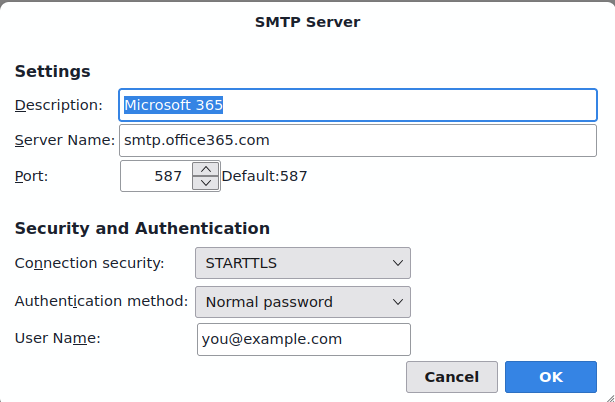
Microsoft 365 SMTP settings in Thunderbird
The outgoing server dialog with Microsoft 365's details entered. Outlook and Apple Mail ask for the same four things under slightly different names.
Which port should you use for Microsoft 365?
STARTTLS on 587. Port 465 (SSL/TLS) is not supported for Microsoft 365 SMTP AUTH.
STARTTLS
Starts as a plain connection, then upgrades to an encrypted one. The modern standard for sending.
SSL/TLS
Microsoft 365 does not accept SSL/TLS on 465. Use the STARTTLS port instead.
Plain SMTP
Meant for server-to-server relay. Home networks and cloud hosts block it, so do not use it to send from a client.
Why your Microsoft 365 connection is failing
The failures people actually hit with Microsoft 365, and what fixes each one.
SMTP AUTH is off for that mailbox or the whole tenant. Run Get-CASMailbox -Identity <address> | Format-List SmtpClientAuthenticationDisabled, and if it says True run Set-CASMailbox -Identity <address> -SmtpClientAuthenticationDisabled $false.
The app is sending From an address that is not the account it signed in with. Give the sign-in account Send As permission on that mailbox, or move the app onto SMTP relay with a connector instead.
Microsoft does not support port 465 for client submission and says a device that defaults to it lacks the required TLS versions. Use port 587, or 25 if 587 is blocked.
Exchange Online rejects TLS 1.0 and 1.1 on smtp.office365.com. Update the firmware, or have an admin set AllowLegacyTLSClients to True with Set-TransportConfig and repoint the device at smtp-legacy.office365.com.
Microsoft throttles the default onmicrosoft.com domain to 100 external recipients per organization in a rolling 24 hours. Send from a verified custom domain instead.
Microsoft 365 sending limits
SMTP client submission is also capped at 30 messages per minute, and anything over that is throttled and carried into the following minutes rather than blocking the account. A separate tenant-wide external recipient limit applies, sized by how many licences you hold, and is shown in the Exchange admin center mail flow reports.
Per day
10,000 recipients per mailbox per day
Recipients per message
Customisable by the admin between 1 and 1,000 recipients
Max attachment
35 MB default maximum send size per message, 36 MB to receive, and an admin can set anything from 1 MB to 150 MB
Compare all 51 providers' sending limits in one table with a source link and a confidence rating for each.
Microsoft 365 servers by region and plan
Microsoft 365 does not use one set of hostnames everywhere. Match the row to your account.
| Region or plan | SMTP | IMAP | POP3 |
|---|---|---|---|
| Worldwide commercial cloud | smtp.office365.com, port 587 or 25, STARTTLS | outlook.office365.com, port 993, SSL | outlook.office365.com, port 995, SSL |
| China, Microsoft 365 operated by 21Vianet | smtp.partner.outlook.cn, port 587, TLS | partner.outlook.cn, port 993, SSL | partner.outlook.cn, port 995, SSL |
| Opt-in endpoint for devices stuck on TLS 1.0 or 1.1 | smtp-legacy.office365.com | Not applicable | Not applicable |
Microsoft 365 quirks by mail client
Outlook
Outlook desktop does not use SMTP AUTH at all, so switching it on changes nothing for Outlook users and matters only for apps, printers and POP or IMAP clients.
Thunderbird
Microsoft names Thunderbird as a client already updated to sign in to Exchange Online with OAuth, so it can connect without basic authentication.
Sending cold email through Microsoft 365
Up to 10,000 recipients per day and 30 messages per minute per mailbox. SMTP AUTH must be enabled on the mailbox by a Microsoft 365 admin: it is off by default on many tenants. Microsoft has disabled Basic Authentication for IMAP and POP on Exchange Online, so those protocols now require OAuth/modern auth on most tenants and an app password often will not connect.
Those caps make single-mailbox sending fine for personal mail but a poor fit for cold outreach at volume. Emailchaser spreads sending across warmed inboxes and manages deliverability, so you can scale without burning Microsoft 365 accounts.
A new Microsoft 365 mailbox also starts with no sending history, and hitting the cap above on its first day is what gets it filtered. Warm the mailbox up first so its daily volume climbs gradually toward that limit rather than starting at it. Emailchaser includes that ramp on every plan.
Other business email and web hosting
Setting up more than one mailbox? These sit in the same category as Microsoft 365.

Common questions about Microsoft 365 SMTP settings
What are Microsoft 365's SMTP settings?
Microsoft 365's outgoing (SMTP) server is smtp.office365.com. Use port 587 (STARTTLS). STARTTLS on 587. Port 465 (SSL/TLS) is not supported for Microsoft 365 SMTP AUTH. Sign in with your full email address and password (or app password).
What is Microsoft 365's IMAP or POP3 server?
Microsoft 365's incoming IMAP server is outlook.office365.com on port 993 (SSL/TLS). If you prefer POP3, use outlook.office365.com on port 995.
Which port should I use for Microsoft 365?
Use port 587 with STARTTLS wherever it's offered, it's the modern standard for authenticated sending. Port 465 with SSL/TLS is a solid alternative. Avoid port 25, which most networks block for client sending. Microsoft 365's recommended value is above.
Why won't my Microsoft 365 SMTP connection work?
Check authentication first: SMTP AUTH must be enabled on the mailbox by a Microsoft 365 admin: it is off by default on many tenants. Microsoft has disabled Basic Authentication for IMAP and POP on Exchange Online, so those protocols now require OAuth/modern auth on most tenants and an app password often will not connect. Use an app password if security defaults or MFA are enforced and SMTP AUTH still allows Basic Auth; otherwise the client must sign in with modern auth (OAuth). Then confirm the host, port and security method match exactly, a 587/SSL or 465/STARTTLS mismatch will fail to connect.
Can I send bulk or cold email through Microsoft 365?
Not at scale. Up to 10,000 recipients per day and 30 messages per minute per mailbox. Providers throttle bursts to fight spam, so pushing cold email through one mailbox hits limits and wrecks deliverability. High-volume outreach belongs on dedicated infrastructure that spreads sending across warmed inboxes, which is what Emailchaser does.
Why does SMTP fail on a brand new tenant even though the password is correct?
Microsoft disables SMTP AUTH for organizations created after January 2020, and it stays off until an admin enables it. Turn it on for the one mailbox the app uses, under Users, Active users, Mail, Manage email apps. Leaving it off for everyone else is Microsoft's own recommendation.
Is basic authentication for SMTP going away?
Yes, but not yet. Microsoft removed basic authentication for POP, IMAP, Exchange Web Services, ActiveSync and Outlook back in 2022, leaving SMTP client submission as the last exception, and it still works today. Microsoft's current published timeline turns it off by default for existing tenants at the end of December 2026, makes it unavailable to tenants created after that, and promises a final removal date in the second half of 2027. Moving the app to OAuth now avoids the deadline entirely.
We need to send more mail than one mailbox allows. What are the options?
Microsoft points at three alternatives. SMTP relay uses an inbound connector on port 25 authenticated by certificate or static IP and needs no licensed mailbox. High Volume Email covers large internal sends. Azure Communication Services Email covers high volume to external recipients.
Ready to 10x your pipeline?
Send your first cold email campaign today.
Start my free trial