Mailjet SMTP Settings

Sinch-owned French sender whose SMTP login is an API key and secret key pair.
Search for your email provider
Outgoing mail (SMTP)
SMTP server
in-v3.mailjet.com
Port. STARTTLS
587
Port. SSL/TLS
465
Security
STARTTLS on 587 (recommended) or SSL/TLS on 465.
Incoming mail (IMAP)
IMAP
Not supported. This is a send-only service.
Incoming mail (POP3)
POP3
Not supported by this provider.
Sending limits & login
Daily send limit
200 emails per day on the free plan; higher on paid plans.
Authentication
Use your Mailjet API Key as the SMTP username and your Secret Key as the password, not your account login.
App password
Find both under Account settings > API Key Management (REST API, SMTP and SEND API Settings).
Mailjet is a send-only relay: there is no IMAP or POP inbox.
Sending cold email? EmailChaser manages inboxes, warmup and deliverability for you.
Try EmailChaser freeFind the SMTP, IMAP and POP3 server settings for any email provider. Free, with no signup, every field copies with one click.
Mailjet SMTP, IMAP and POP3 settings
Mailjet is a French sending service now owned by Sinch. Its relay, in-v3.mailjet.com, is unusual in what it wants for a login: the username is your API key and the password is your secret key, both taken from the same settings page. It is also one of the few relays that publishes port 80 and port 588 alongside the usual ports, so there is almost always a way out of a restrictive network.
Mailjet is a send-only relay, so there's no IMAP or POP3 inbox. You only configure the SMTP server above. Use the tool to copy each value into your app or script.
Checked against Mailjet's own documentation: dev.mailjet.com, documentation.mailjet.com, mailjet.com. Ports and limits change, so check there too if something will not connect.
Mailjet settings at a glance
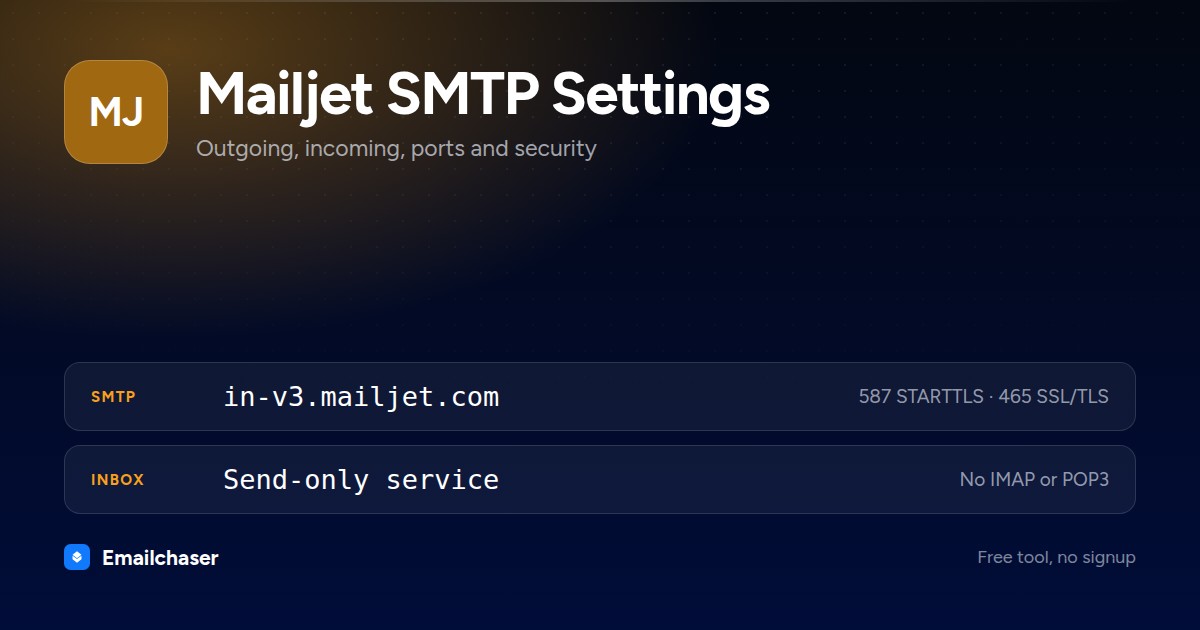
One card with every server and port on it. Right click to save it, or share the page and this is the preview people see.
What to enter as your Mailjet username and password
Wrong credentials, not a wrong port, are the usual reason a Mailjet connection fails. These are the exact values to type.
Your Mailjet API key (the public key), not your account email address
How to set up Mailjet in a mail client
The exact path through Mailjet's own settings, in order.
- 1
Validate the sender you will send from
Add and confirm the address or domain under Account settings > Sender domains & addresses (https://app.mailjet.com/account/sender) before you try to relay anything.
- 2
Open your SMTP and SEND API settings
Go to Account settings > SMTP and SEND API settings, or straight to https://app.mailjet.com/account/apikeys, where Mailjet shows the server name, the available ports, your API key and your secret key. The secret key is displayed only once, at creation.
- 3
Enter the relay details
Server in-v3.mailjet.com. Mailjet's published port table is 25, 80, 587/588 and 2525, all with TLS optional, plus 465, which is the only port it accepts SSL on.
- 4
Use the key pair as the login
Username is the API key, password is the secret key. Store the secret key somewhere safe when it is first shown.
- 5
Optional: tag sends with Mailjet X-headers
Add X-Mailjet-Campaign to group messages into a single line in your dashboard, or X-MJ-TemplateID to render a template you saved in Mailjet.
What Mailjet looks like filled in
Every mail client asks for the same handful of fields. Here they are with Mailjet's values already in place.
Account settings: Mailjet
Server
in-v3.mailjet.comPort
587Encryption
STARTTLSAuthentication
RequiredUsername
Your Mailjet API key (the public key), not your account email addressPassword
Your Mailjet secret key, the private half of the same key pairIMAP / POP3
Not applicable. Mailjet sends only, so there is no inbox to configure.An illustration of the fields, not a screenshot of any one app. Field names differ slightly between Outlook, Apple Mail and Thunderbird; the values do not.
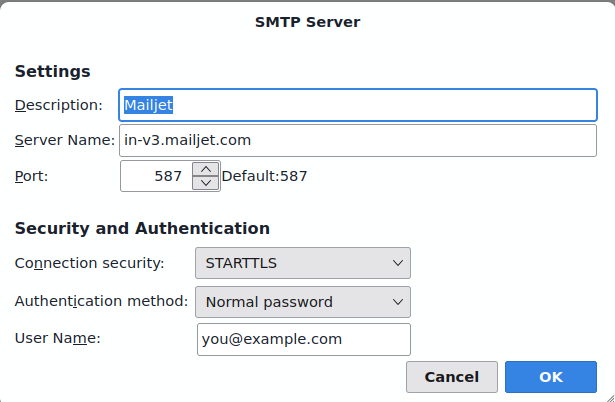
Mailjet SMTP settings in Thunderbird
The outgoing server dialog with Mailjet's details entered. Outlook and Apple Mail ask for the same four things under slightly different names.
Which port should you use for Mailjet?
STARTTLS on 587 (recommended) or SSL/TLS on 465.
STARTTLS
Starts as a plain connection, then upgrades to an encrypted one. The modern standard for sending.
SSL/TLS
Encrypted from the first byte. Widely supported and a good choice when 587 is blocked.
Plain SMTP
Meant for server-to-server relay. Home networks and cloud hosts block it, so do not use it to send from a client.
Why your Mailjet connection is failing
The failures people actually hit with Mailjet, and what fixes each one.
Mailjet never uses your account email and dashboard password for SMTP. Put the API key in the username box and the secret key in the password box, both from Account settings > SMTP and SEND API settings.
Your network is blocking the port. Mailjet also answers on 587, 588, 2525, 465 and 80, and it points out that port 80 is open in virtually every network, so try that one.
465 is the only Mailjet port that accepts SSL from the first byte. On 25, 80, 587, 588 or 2525 use TLS via STARTTLS instead.
The free plan allows 200 a day inside 6,000 a month. Anything over is queued and released the next calendar day, and Mailjet deletes queued mail after 3 days.
Mailjet caps the total message at 15 MB on every plan, and that figure includes base64-encoded attachments, which are roughly a third larger than the files on disk.
Mailjet sending limits
The free plan is 6,000 a month with the 200 a day cap on top; overflow queues for 3 days and is then deleted
Per day
200 emails a day on the free plan
Max attachment
15 MB for the whole message including attachments, on every plan
Compare all 51 providers' sending limits in one table with a source link and a confidence rating for each.
Mailjet quirks by mail client
Thunderbird
Mailjet's own guide has you add the server under Tools > Accounts > Outgoing Server (SMTP) with port 465, connection security SSL/TLS and authentication method Normal password. Thunderbird prompts for the secret key as the password on the first send.
Outlook
Set the outgoing server to in-v3.mailjet.com, tick 'My outgoing server requires authentication', which Outlook leaves off by default, then set port 465 with SSL under Advanced Options.
Sending cold email through Mailjet
200 emails per day on the free plan; higher on paid plans. Use your Mailjet API Key as the SMTP username and your Secret Key as the password, not your account login.
Those caps make single-mailbox sending fine for personal mail but a poor fit for cold outreach at volume. Emailchaser spreads sending across warmed inboxes and manages deliverability, so you can scale without burning Mailjet accounts.
A new Mailjet mailbox also starts with no sending history, and hitting the cap above on its first day is what gets it filtered. Warm the mailbox up first so its daily volume climbs gradually toward that limit rather than starting at it. Emailchaser includes that ramp on every plan.
Other smtp sending services
Setting up more than one mailbox? These sit in the same category as Mailjet.

Common questions about Mailjet SMTP settings
What are Mailjet's SMTP settings?
Mailjet's outgoing (SMTP) server is in-v3.mailjet.com. Use port 587 (STARTTLS) or 465 (SSL/TLS). STARTTLS on 587 (recommended) or SSL/TLS on 465. Sign in with the SMTP credentials Mailjet issues you, not a mailbox address and password.
What is Mailjet's IMAP or POP3 server?
Mailjet is a send-only service, so it has no IMAP or POP3 inbox. You configure it as an outgoing SMTP server only.
Which port should I use for Mailjet?
Use port 587 with STARTTLS wherever it's offered, it's the modern standard for authenticated sending. Port 465 with SSL/TLS is a solid alternative. Avoid port 25, which most networks block for client sending. Mailjet's recommended value is above.
Why won't my Mailjet SMTP connection work?
Check authentication first: Use your Mailjet API Key as the SMTP username and your Secret Key as the password, not your account login. Find both under Account settings > API Key Management (REST API, SMTP and SEND API Settings). Then confirm the host, port and security method match exactly, a 587/SSL or 465/STARTTLS mismatch will fail to connect.
Can I send bulk or cold email through Mailjet?
Not at scale. 200 emails per day on the free plan; higher on paid plans. Providers throttle bursts to fight spam, so pushing cold email through one mailbox hits limits and wrecks deliverability. High-volume outreach belongs on dedicated infrastructure that spreads sending across warmed inboxes, which is what Emailchaser does.
What goes in the username box for Mailjet SMTP?
Your API key, which Mailjet also calls the public key. The secret key goes in the password box. Both are on Account settings > SMTP and SEND API settings. Your email address and website password will not authenticate against in-v3.mailjet.com.
What happens when I go over 200 emails in a day on the free plan?
The extra messages are not rejected outright. Mailjet queues them and starts sending again the next calendar day. Queued mail only survives 3 days, after which it is removed from the system for good.
Which Mailjet port should I pick when my host blocks the usual ones?
Port 80. Mailjet lists it in its official port table alongside 25, 587, 588 and 2525 precisely because it is open almost everywhere. It still runs SMTP, not web traffic. Port 588 is another Mailjet-specific option most other relays do not offer.
Ready to 10x your pipeline?
Send your first cold email campaign today.
Start my free trial