cPanel Hosting SMTP Settings
A hosting control panel rather than an email provider; your host runs the mail server
Search for your email provider
Outgoing mail (SMTP)
SMTP server
mail.yourdomain.com
Port. STARTTLS
587
Port. SSL/TLS
465
Security
SSL/TLS on 465 (recommended) or STARTTLS on 587.
Incoming mail (IMAP)
IMAP server
mail.yourdomain.com
Port. SSL/TLS
993
Port. STARTTLS
143
Incoming mail (POP3)
POP3 server
mail.yourdomain.com
Port. SSL/TLS
995
Port. STARTTLS
110
Sending limits & login
Daily send limit
Most shared hosts cap sending at a few hundred messages per hour per account.
Authentication
Sign in with your full email address and the mailbox password set in cPanel > Email Accounts.
App password
No app password. cPanel mailboxes use the mailbox password directly.
The generic pattern used by most cPanel web hosts. cPanel > Email Accounts > Connect Devices always shows the exact hostnames and ports for your server.
Sending cold email? EmailChaser manages inboxes, warmup and deliverability for you.
Try EmailChaser freeFind the SMTP, IMAP and POP3 server settings for any email provider. Free, with no signup, every field copies with one click.
cPanel Hosting SMTP, IMAP and POP3 settings
cPanel is not an email company. It is the control panel your web host runs, and the mailbox sits on your host's server. Its Email Accounts screen has a Connect Devices link that prints the exact settings for your account, and it swaps mail.yourdomain.com for the server's own hostname whenever no certificate covers your domain. Your host can hide that screen entirely.
For incoming mail, use the IMAP server mail.yourdomain.com on port 993, or POP3 at mail.yourdomain.com on port 995. Pick the exact values from the tool above and copy them straight into your mail client.
Checked against cPanel Hosting's own documentation: docs.cpanel.net. Ports and limits change, so check there too if something will not connect.
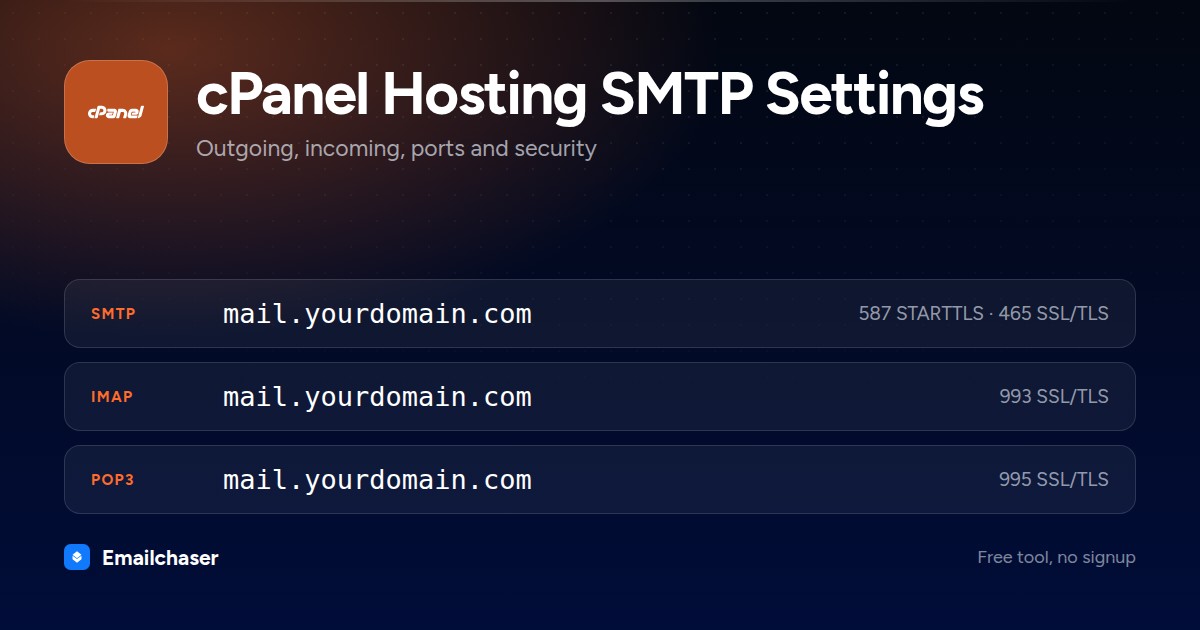
cPanel Hosting settings at a glance
One card with every server and port on it. Right click to save it, or share the page and this is the preview people see.
What to enter as your cPanel Hosting username and password
Wrong credentials, not a wrong port, are the usual reason a cPanel Hosting connection fails. These are the exact values to type.
Your full email address, for example you@yourdomain.com
The mailbox password set in cPanel's Email Accounts screen
How to set up cPanel Hosting in a mail client
The exact path through cPanel Hosting's own settings, in order.
- 1
Open Connect Devices
cPanel > Home > Email > Email Accounts, then click Connect Devices next to the address you want to set up.
- 2
Try the automatic configuration script first
The top of that page offers scripts for iOS, macOS Mail and Windows Live Mail. Every other client has to be set up by hand.
- 3
Copy the Secure SSL/TLS block
IMAP on port 993 or POP3 on port 995 incoming, SMTP on port 465 outgoing, with your full email address as the username.
- 4
Use the hostname exactly as shown
cPanel prints mail.yourdomain.com only when a valid certificate covers it, and the server's own hostname otherwise. Typing the other one causes certificate warnings.
- 5
Skip the client and use webmail
Webmail runs on port 2096 over SSL, for example https://yourdomain.com:2096, or through the Check Email action in Email Accounts.
What cPanel Hosting looks like filled in
Every mail client asks for the same handful of fields. Here they are with cPanel Hosting's values already in place.
Account settings: cPanel Hosting
Server
mail.yourdomain.comPort
465Encryption
SSL/TLSAuthentication
RequiredUsername
Your full email address, for example you@yourdomain.comPassword
The mailbox password set in cPanel's Email Accounts screenServer
mail.yourdomain.comPort
993Encryption
SSL/TLSAn illustration of the fields, not a screenshot of any one app. Field names differ slightly between Outlook, Apple Mail and Thunderbird; the values do not.
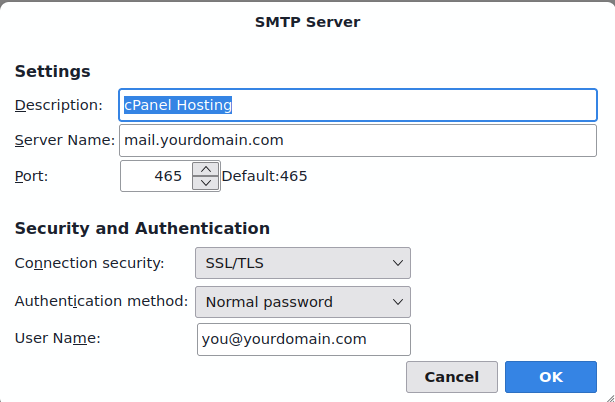
cPanel Hosting SMTP settings in Thunderbird
The outgoing server dialog with cPanel Hosting's details entered. Outlook and Apple Mail ask for the same four things under slightly different names.
Which port should you use for cPanel Hosting?
SSL/TLS on 465 (recommended) or STARTTLS on 587.
STARTTLS
Starts as a plain connection, then upgrades to an encrypted one. The modern standard for sending.
SSL/TLS
Encrypted from the first byte. Widely supported and a good choice when 587 is blocked.
Plain SMTP
Meant for server-to-server relay. Home networks and cloud hosts block it, so do not use it to send from a client.
Why your cPanel Hosting connection is failing
The failures people actually hit with cPanel Hosting, and what fixes each one.
cPanel shows the server's hostname instead of mail.yourdomain.com when no certificate covers the mail subdomain. Use whichever name the Connect Devices page actually prints.
Hosts can switch those interfaces off in WHM's Feature Manager. Ask the host to enable it or to give you the mail settings directly.
cPanel greylisting defers unknown senders, five minutes by default, then accepts the retry. The host can add the sender under WHM > Email > Greylisting > Trusted Hosts.
WHM's SMTP Restrictions blocks everything except the mail server, Mailman and root from making outbound SMTP connections. Ask the host to disable it or send through the local mail server.
The phone was set up on the POP3 port, which downloads messages and removes them from the server. Use IMAP on 993 so every device sees the same mailbox.
cPanel Hosting quirks by mail client
Apple Mail
cPanel can generate a configuration file for macOS Mail and iOS from the Connect Devices page, so you do not type any settings by hand.
Outlook
There is no cPanel auto-configuration script for Outlook, so copy the Secure SSL/TLS values across manually.
Sending cold email through cPanel Hosting
Most shared hosts cap sending at a few hundred messages per hour per account. Sign in with your full email address and the mailbox password set in cPanel > Email Accounts.
Those caps make single-mailbox sending fine for personal mail but a poor fit for cold outreach at volume. Emailchaser spreads sending across warmed inboxes and manages deliverability, so you can scale without burning cPanel Hosting accounts.
A new cPanel Hosting mailbox also starts with no sending history, and hitting the cap above on its first day is what gets it filtered. Warm the mailbox up first so its daily volume climbs gradually toward that limit rather than starting at it. Emailchaser includes that ramp on every plan.
Other business email and web hosting
Setting up more than one mailbox? These sit in the same category as cPanel Hosting.


Common questions about cPanel Hosting SMTP settings
What are cPanel Hosting's SMTP settings?
cPanel Hosting's outgoing (SMTP) server is mail.yourdomain.com. Use port 587 (STARTTLS) or 465 (SSL/TLS). SSL/TLS on 465 (recommended) or STARTTLS on 587. Sign in with your full email address and password (or app password).
What is cPanel Hosting's IMAP or POP3 server?
cPanel Hosting's incoming IMAP server is mail.yourdomain.com on port 993 (SSL/TLS). If you prefer POP3, use mail.yourdomain.com on port 995.
Which port should I use for cPanel Hosting?
Use port 587 with STARTTLS wherever it's offered, it's the modern standard for authenticated sending. Port 465 with SSL/TLS is a solid alternative. Avoid port 25, which most networks block for client sending. cPanel Hosting's recommended value is above.
Why won't my cPanel Hosting SMTP connection work?
Check authentication first: Sign in with your full email address and the mailbox password set in cPanel > Email Accounts. No app password. cPanel mailboxes use the mailbox password directly. Then confirm the host, port and security method match exactly, a 587/SSL or 465/STARTTLS mismatch will fail to connect.
Can I send bulk or cold email through cPanel Hosting?
Not at scale. Most shared hosts cap sending at a few hundred messages per hour per account. Providers throttle bursts to fight spam, so pushing cold email through one mailbox hits limits and wrecks deliverability. High-volume outreach belongs on dedicated infrastructure that spreads sending across warmed inboxes, which is what Emailchaser does.
Is cPanel my email provider?
No. cPanel is software your hosting company installs, and the mailbox lives on that company's server. Settings, limits and support all come from the host. cPanel only decides what the screens look like, which is why the same Connect Devices page appears at Bluehost, HostGator and hundreds of smaller hosts.
Should I type mail.mydomain.com or the server name?
Use whichever one the Connect Devices page prints for your account. cPanel generates that hostname based on the certificate: your own domain when a valid certificate covers it, and the server's hostname when it does not. Picking the other one is the usual cause of a certificate mismatch warning.
Why does mail from a new sender always arrive late?
Most likely greylisting, a cPanel anti-spam feature that temporarily rejects the first message from an unrecognised combination of sender IP, sender address and recipient. Real mail servers retry and get through, with a five minute default delay. Your host can trust a sender or a whole provider in WHM > Email > Greylisting.
Ready to 10x your pipeline?
Send your first cold email campaign today.
Start my free trial