iCloud Mail SMTP Settings
Apple's mail service for iCloud addresses, IMAP only, with no POP support at all.
Search for your email provider
Outgoing mail (SMTP)
SMTP server
smtp.mail.me.com
Port. STARTTLS
587
Security
STARTTLS on 587.
Incoming mail (IMAP)
IMAP server
imap.mail.me.com
Port. SSL/TLS
993
Incoming mail (POP3)
POP3
Not supported by this provider.
Sending limits & login
Daily send limit
About 1,000 messages per day and up to 500 recipients per day.
Authentication
Requires an app-specific password: your Apple ID password will not work in third-party clients.
App password
Create one at appleid.apple.com after enabling two-factor authentication.
iCloud Mail does not support POP3. Use IMAP for incoming mail.
Sending cold email? EmailChaser manages inboxes, warmup and deliverability for you.
Try EmailChaser freeFind the SMTP, IMAP and POP3 server settings for any email provider. Free, with no signup, every field copies with one click.
iCloud Mail SMTP, IMAP and POP3 settings
iCloud Mail is Apple's mailbox, and it is the odd one out here: Apple supports IMAP and SMTP but no POP whatsoever. It also wants two different usernames, the short name before the @ for incoming mail and the full address for outgoing. Because Mail shares your iCloud storage, filling the free 5 GB tier stops you sending and receiving entirely.
For incoming mail, use the IMAP server imap.mail.me.com on port 993. Pick the exact values from the tool above and copy them straight into your mail client.
Checked against iCloud Mail's own documentation: support.apple.com. Ports and limits change, so check there too if something will not connect.
iCloud Mail settings at a glance
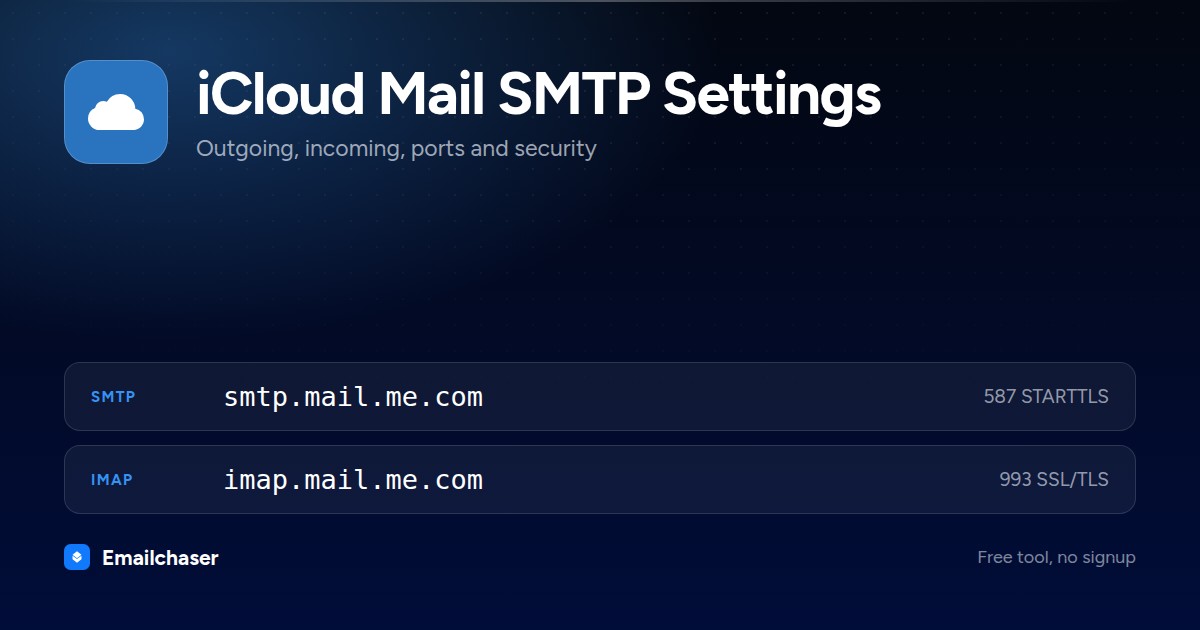
One card with every server and port on it. Right click to save it, or share the page and this is the preview people see.
What to enter as your iCloud Mail username and password
Wrong credentials, not a wrong port, are the usual reason a iCloud Mail connection fails. These are the exact values to type.
Different on each server: the short name before the @ for IMAP (johnappleseed), the full address for SMTP (johnappleseed@icloud.com)
An app-specific password generated on your Apple Account; the same one is used for both the incoming and outgoing server
Get your app-specific passwordHow to set up iCloud Mail in a mail client
The exact path through iCloud Mail's own settings, in order.
- 1
Turn on two-factor authentication first
App-specific passwords only exist on Apple Accounts protected by two-factor authentication. Check it at https://account.apple.com under Sign-In and Security.
- 2
Create your primary iCloud Mail address
Go to icloud.com/mail and select Create Email Address. Apple will not let you rename this address afterwards, so pick carefully.
- 3
Generate an app-specific password
At https://account.apple.com open Sign-In and Security, choose App-Specific Passwords, then Generate an app-specific password. You can hold 25 at a time.
- 4
Set incoming mail to imap.mail.me.com
Port 993 with SSL required. The username is usually the short name only, for example johnappleseed, not johnappleseed@icloud.com. If the app cannot connect, try the full address.
- 5
Set outgoing mail to smtp.mail.me.com
Port 587, SSL required and SMTP authentication on. Here the username is the full address, johnappleseed@icloud.com, with the same app-specific password.
What iCloud Mail looks like filled in
Every mail client asks for the same handful of fields. Here they are with iCloud Mail's values already in place.
Account settings: iCloud Mail
Server
smtp.mail.me.comPort
587Encryption
STARTTLSAuthentication
RequiredUsername
Different on each server: the short name before the @ for IMAP (johnappleseed), the full address for SMTP (johnappleseed@icloud.com)Password
An app-specific password generated on your Apple Account; the same one is used for both the incoming and outgoing serverServer
imap.mail.me.comPort
993Encryption
SSL/TLSAn illustration of the fields, not a screenshot of any one app. Field names differ slightly between Outlook, Apple Mail and Thunderbird; the values do not.
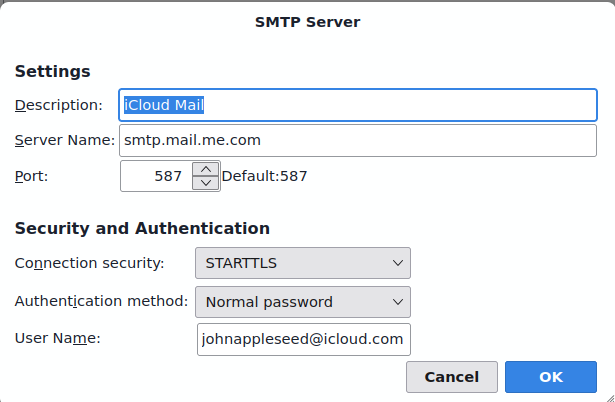
iCloud Mail SMTP settings in Thunderbird
The outgoing server dialog with iCloud Mail's details entered. Outlook and Apple Mail ask for the same four things under slightly different names.
Which port should you use for iCloud Mail?
STARTTLS on 587.
STARTTLS
Starts as a plain connection, then upgrades to an encrypted one. The modern standard for sending.
SSL/TLS
iCloud Mail does not accept SSL/TLS on 465. Use the STARTTLS port instead.
Plain SMTP
Meant for server-to-server relay. Home networks and cloud hosts block it, so do not use it to send from a client.
Why your iCloud Mail connection is failing
The failures people actually hit with iCloud Mail, and what fixes each one.
Apple uses a different username on each server. Put the short name in the IMAP username field and the full @icloud.com address in the SMTP username field, with the same app-specific password in both.
Apple states that iCloud Mail does not support POP at all. The account has to be set up as IMAP on imap.mail.me.com port 993, or it will never connect.
That section only appears once two-factor authentication is on. Turn it on at account.apple.com, then App-Specific Passwords shows up under Sign-In and Security.
Apple lists these as its over-the-limit alerts. You get 1,000 messages and 1,000 recipients a day and 500 recipients per message. Clear stuck copies out of the Outbox and resend later.
iCloud Mail is stored inside your iCloud storage. Apple says a full account cannot send or receive email at all. Free up space or move to iCloud+.
iCloud Mail sending limits
Apple describes iCloud Mail as a personal service and prohibits unsolicited bulk sending; exceeding a limit produces a named alert rather than a silent drop.
Per day
1,000 messages per day
Recipients per message
500 recipients per message, and 1,000 recipients per day
Max attachment
20 MB per message, or up to 5 GB with Mail Drop turned on
Compare all 51 providers' sending limits in one table with a source link and a confidence rating for each.
iCloud Mail quirks by mail client
Outlook
Apple says Outlook 2021 and later on Windows can be authorised with your Apple Account directly, so no manual server entries or app-specific password are needed.
Apple Mail
On macOS High Sierra 10.13 or later, Apple wants the account added through iCloud settings rather than typed in by hand.
Sending cold email through iCloud Mail
About 1,000 messages per day and up to 500 recipients per day. Requires an app-specific password: your Apple ID password will not work in third-party clients.
Those caps make single-mailbox sending fine for personal mail but a poor fit for cold outreach at volume. Emailchaser spreads sending across warmed inboxes and manages deliverability, so you can scale without burning iCloud Mail accounts.
A new iCloud Mail mailbox also starts with no sending history, and hitting the cap above on its first day is what gets it filtered. Warm the mailbox up first so its daily volume climbs gradually toward that limit rather than starting at it. Emailchaser includes that ramp on every plan.
Other consumer email providers
Setting up more than one mailbox? These sit in the same category as iCloud Mail.


Common questions about iCloud Mail SMTP settings
What are iCloud Mail's SMTP settings?
iCloud Mail's outgoing (SMTP) server is smtp.mail.me.com. Use port 587 (STARTTLS). STARTTLS on 587. Sign in with your full email address and password (or app password).
What is iCloud Mail's IMAP or POP3 server?
iCloud Mail's incoming IMAP server is imap.mail.me.com on port 993 (SSL/TLS). POP3 is not supported.
Which port should I use for iCloud Mail?
Use port 587 with STARTTLS wherever it's offered, it's the modern standard for authenticated sending. Port 465 with SSL/TLS is a solid alternative. Avoid port 25, which most networks block for client sending. iCloud Mail's recommended value is above.
Why won't my iCloud Mail SMTP connection work?
Check authentication first: Requires an app-specific password: your Apple ID password will not work in third-party clients. Create one at appleid.apple.com after enabling two-factor authentication. Then confirm the host, port and security method match exactly, a 587/SSL or 465/STARTTLS mismatch will fail to connect.
Can I send bulk or cold email through iCloud Mail?
Not at scale. About 1,000 messages per day and up to 500 recipients per day. Providers throttle bursts to fight spam, so pushing cold email through one mailbox hits limits and wrecks deliverability. High-volume outreach belongs on dedicated infrastructure that spreads sending across warmed inboxes, which is what Emailchaser does.
Can I use my iCloud+ custom email domain in Outlook or Thunderbird?
The servers do not change: it is still imap.mail.me.com and smtp.mail.me.com with an app-specific password. Custom Email Domain is an iCloud+ feature, needs two-factor authentication and an existing primary iCloud Mail address, and Apple notes it is not available in every country or region.
Why does the same password not seem to work for both servers?
It does. Apple tells you to reuse the app-specific password you created for the incoming server on the outgoing server as well. What actually differs is the username, short name for IMAP and full address for SMTP, and that mismatch is the usual cause of a working inbox with broken sending.
Can I change my @icloud.com address later?
No. Apple says the primary iCloud Mail address cannot be renamed once it is created. You can add email aliases and send from those, but the primary address stays as your SMTP username.
Ready to 10x your pipeline?
Send your first cold email campaign today.
Start my free trial